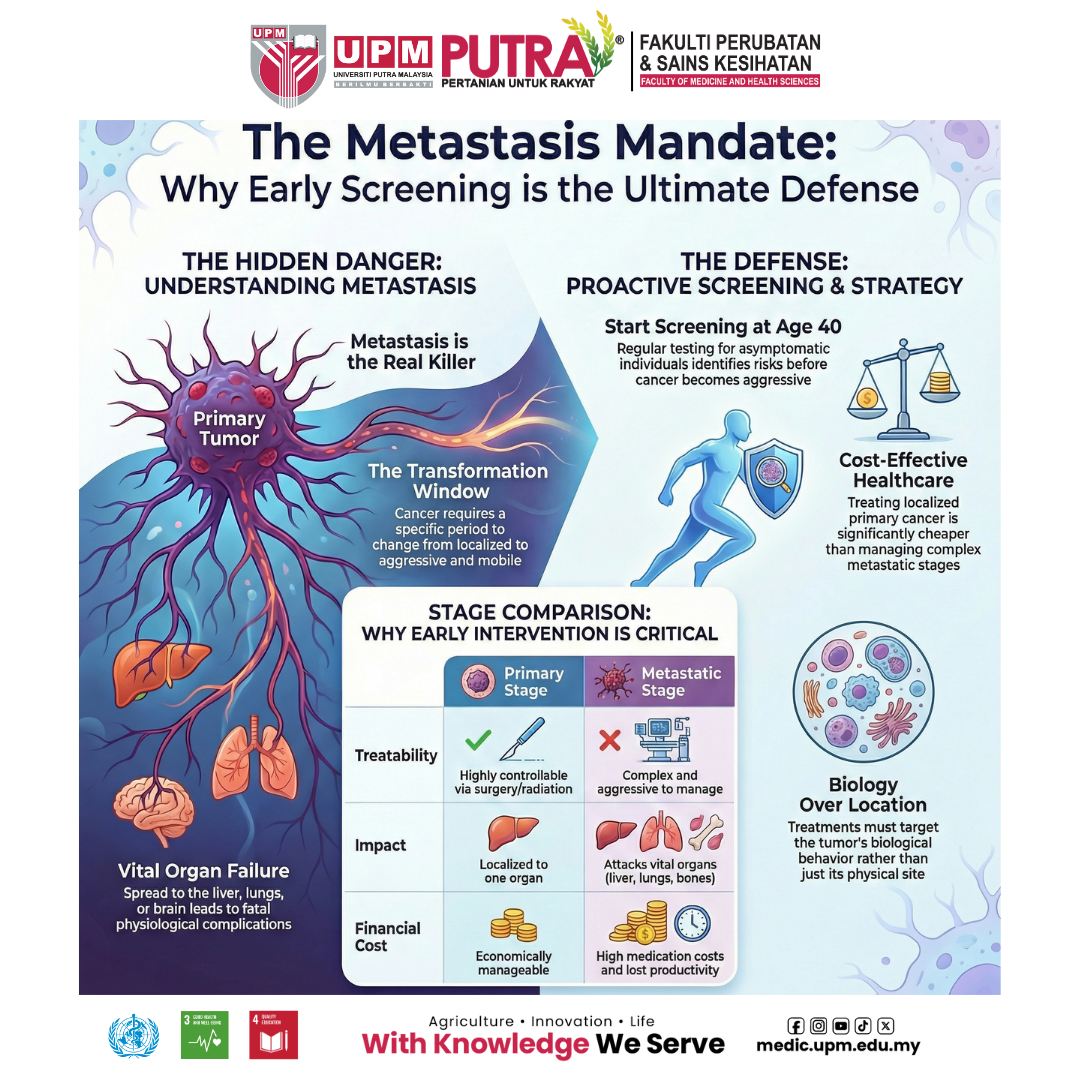
Metastasis: The Leading Cause of Death in Cancer Patients
In conjunction with World Cancer Day, held every year on February 4th and recognized by the United Nations, it is timely for us to pause and reflect on how society understands cancer, especially the real reasons why it continues to claim so many lives worldwide, including in Malaysia.
In public conversations, cancer is often portrayed as deadly simply because of the presence of a tumor in organs like the breast, lungs, or colon. While this is not entirely incorrect, it is an oversimplification that can obscure a far more critical reality. The truth is that most deaths from cancer do not come from the original tumor, but from a dangerous process known as metastasis, where cancer cells spread to other organs.
Primary tumors can often be treated or controlled, especially if detected early. Surgery, radiotherapy, or systemic treatments can produce good outcomes during this stage. The real challenge begins when cancer cells undergo biological changes that allow them to move, attack surrounding tissue, and spread to vital organs such as the liver, lungs, bones, and brain. When this happens, cancer becomes far more aggressive and complex to manage.
In many cases, patients do not die because of the tumor at its original site, but because the organs that have been invaded by metastasized cancer start to fail. Liver damage, respiratory failure, or neurological complications are often the ultimate cause of death. Despite this, public discussions still place more emphasis on tumor size, whereas the behavior of cancer cells is the key factor in a patient’s prognosis.
Cancer cells need a certain period to transform from being localized to being capable of spreading. This window should be fully used through early detection and targeted intervention. For this reason, strategies to combat cancer cannot remain reactive. They must focus on preventing the spread of cancer from the moment of diagnosis.
Regular cancer screening is a crucial step that needs strengthening, especially starting from the age of 40, even for individuals showing no symptoms. Early screening not only increases the chances of detecting cancer at its primary stage but also helps identify the risk of metastasis sooner. Delays in diagnosis reduce the effectiveness of treatment and can carry serious financial implications for patients and their families.
Treating metastatic cancer is far more expensive than managing primary cancer. Medication costs, long-term follow-ups, loss of productivity, and emotional stress can place a heavy financial burden on families. Therefore, investing in early screening is economically sensible for both patients and the nation’s healthcare system.
Cancer treatment should also be tailored to the biology of the tumor, not just its location. Each type of cancer has different metastatic potential and requires a specific approach. At the same time, local research must be strengthened to understand metastasis patterns among Malaysians, considering genetic, environmental, and lifestyle factors.
Patients and families must be clearly informed about the importance of continuous treatment and long-term monitoring. Stopping treatment too early or skipping follow-ups can give cancer cells the chance to reactivate and spread unnoticed.
In conclusion, reducing cancer deaths in Malaysia can only be achieved by focusing seriously on early detection, regular screening starting at age 40, and controlling metastasis as the core of the national cancer strategy. Understanding how cancer spreads is not just a scientific matter but a vital key to saving more lives and protecting the economic wellbeing of society.

Prof. Madya Dr. Nur Fariesha Md Hashim
Associate Professor
Cancer Biology
Department of Biomedical Sciences
Faculty of Medicine and Health Sciences
Universiti Putra Malaysia
016-2873872
nurfariesha@upm.edu.my
Date of Input: 04/02/2026 | Updated: 04/02/2026 | nadia_rahman
MEDIA SHARING






.png)
.png)