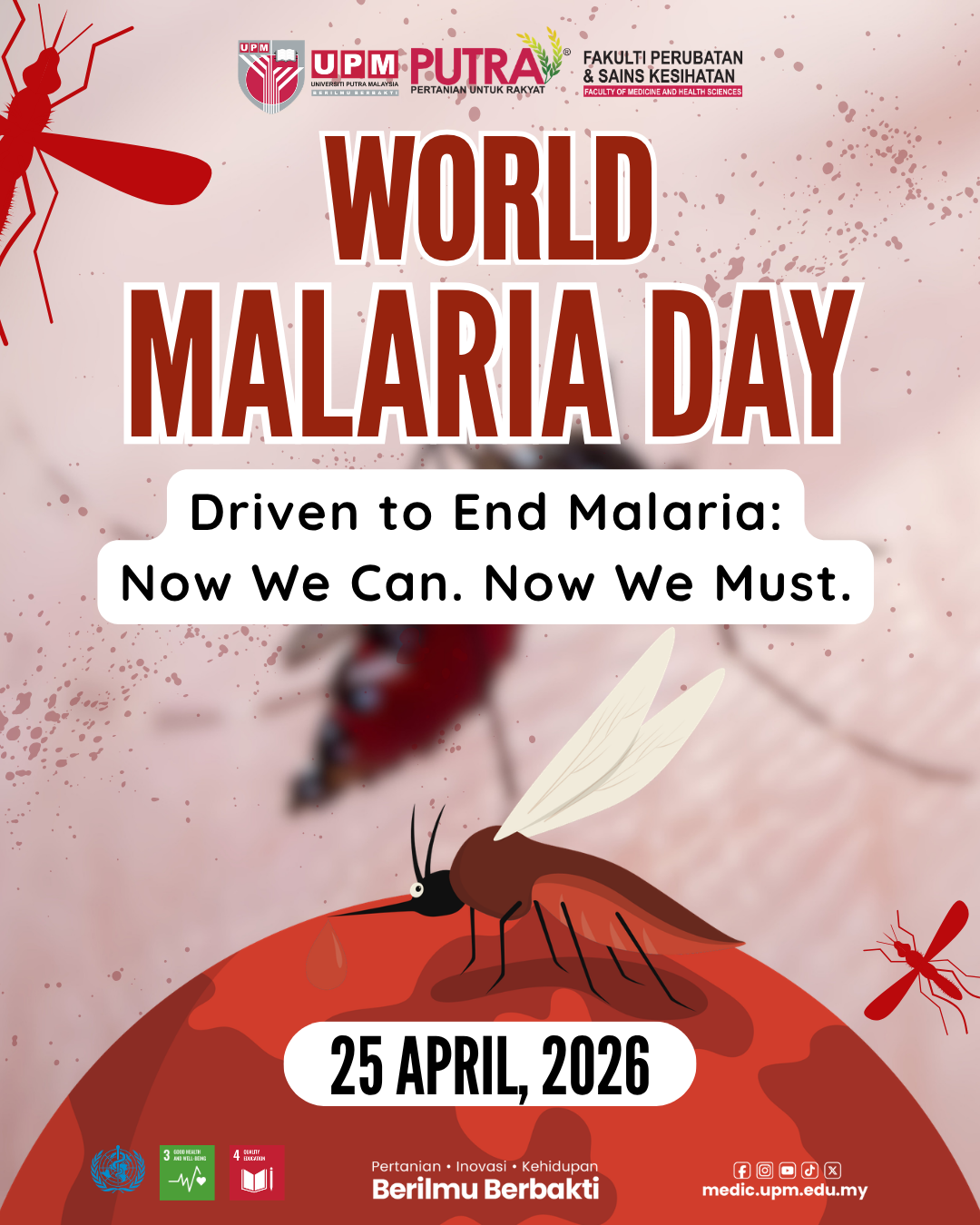
Driven to End Malaria: Now We Can. Now We Must.
Every year on 25 April, the world celebrates World Malaria Day — a day set aside by the World Health Organization (WHO) to raise awareness about malaria, honour those who have lost their lives to the disease, and strengthen the commitment towards its elimination. It was established in 2007 by the World Health Assembly, this annual event serves as a stark reminder that malaria, although preventable and treatable, STILL continues to claim hundreds of thousands of lives each year.
On World Malaria Day 2026, the campaign titled "Driven to End Malaria: Now We Can. Now We Must." was launched, reflecting the urgent need to protect lives today and ensure a malaria-free future.
Malaria is caused by the Plasmodium parasite, which is transmitted to human through the bite of female Anopheles mosquitoes. There are five species that infect humans, of which Plasmodium falciparum is the most dangerous and fatal species while Plasmodium vivax is the most geographically widespread species.
According to the WHO World Malaria Report 2025, there are an estimated 263 million malaria cases and 597,000 deaths worldwide in 2024, with the African region accounting for nearly 94% of all cases. So far, 37 countries have reported fewer than 1,000 cases in 2024.
Children under five and pregnant women are the most vulnerable groups and have contributed to the majority of severe malaria cases leading to death. In addition, malaria also has a significant impact on the economy by reducing productivity, burdening health systems, and perpetuating poverty in malaria-endemic communities.
In Southeast Asia, including Malaysia, Plasmodium knowlesi has emerged as the leading cause of malaria cases in humans, particularly in Sabah and Sarawak. This zoonotic parasite is transmitted from macaque to human through the bite of female Anopheles leucosphyrus mosquitoes in forested areas, and ongoing deforestation has made it easier for this vector to reach humans.
Despite this, Malaysia has managed to record zero cases of indigenous P. falciparum and P. vivax—the result of decades of strategic investment in public health systems, vector control, and data-driven epidemiological surveillance. However, the zoonotic nature of P. knowlesi, which makes wild monkeys as a natural reservoir of the parasite, makes complete eradication much more complex, and the risk of its transmission will remain a long-term challenge and requires continued vigilance.
New Challenges in Combating Malaria
The world is facing a new wave of increasingly complex and interconnected challenges. Drug and insecticide resistance continues to be the most critical threat. One of the most alarming threats is the emergence and spread of resistance to artemisinin-based combination therapies (ACTs), which are the mainstay of malaria treatment. Partial artemisinin resistance, originally identified around the Mekong River in Thailand, has now been confirmed in four African countries — notably Eritrea, Rwanda, Uganda, and Tanzania. Mutations in the Plasmodium falciparum kelch13 (PfK13) gene have slowed the cure process, threatening the effectiveness of key malaria treatments. This is of particular concern because ACTs are a widely used primary treatment option worldwide, particularly in Africa, which bears the largest burden of malaria cases.
At the same time, the spread of pyrethroid resistance in Anopheles mosquito populations is further weakening the effectiveness of insecticide-treated nets (ITNs) and indoor spraying (IRS). These two interventions are the most widely used in worldwide. The spread of insecticide resistance to Africa — previously considered a largely unaffected region — marks a critical turning point in the global malaria control landscape. If resistance continues to spread without effective control, many years of efforts in reducing malaria deaths and cases could be reversed, and the goal of eliminating the disease could become increasingly out of reach.
Climate change is altering the geographic distribution of malaria-carrying mosquitoes. Rising temperatures and changing rainfall patterns are allowing Anopheles mosquitoes to explore highlands in East Africa and parts of South America that were previously too cold for malaria transmission. This has the effect of expanding the geographic boundaries of malaria, exposing new populations to new threats that lack natural immunity and lack the health infrastructure to cope with the disease.
In addition, the continued reduction in funding compared to last year has undermined the sustainability of malaria control programmes. This has affected the distribution of treatment bed nets, diagnostic tests, and access to treatment for those most in need. Humanitarian crises such as armed conflict and large-scale population displacement have also exacerbated the situation and created an environment that is more conducive to malaria transmission among marginalized and vulnerable communities. The combination of climate change, funding shortages, and geopolitical instability has created a multifaceted challenge that requires a global, coordinated, and forward-looking response to ensure that malaria elimination goals are achieved.
Recent Successes and Innovations
The licensing of the RTS,S/AS01 (Mosquirix) vaccine marks a historic moment in malaria prevention. Following a WHO recommendation in 2021, over 12 million doses were administered to children in Ghana, Kenya, and Malawi as part of a pilot program. Efficacy data show an estimated 30–40% reduction in clinical malaria episodes and up to 30% reduction in severe malaria cases among vaccinated children.
More recently, the R21/Matrix-M vaccine, developed by the University of Oxford and the Serum Institute of India, has shown efficacy of up to 77% in phase 2 clinical trials. Several countries have begun national rollout programs in 2025, and early programmatic data from 2026 are expected to provide further information to drive global vaccination strategies. The R21 vaccine in particular holds new promise due to its higher efficacy rate compared to RTS,S, and its potential to be produced in larger quantities and at lower cost. This makes it more accessible to low-income countries and those most affected by malaria.
Innovations in insecticide-treated bed net (ITN) technology have resulted in dual-insecticide bed nets that combine two different active ingredients — either pyrethroid-clofenapyr or pyrethroid-pyriproxyfin — to address the growing problem of insecticide resistance. By 2023, nearly 80% of bed nets supplied in sub-Saharan Africa will be these new generation bed nets, reflecting a rapid shift towards more effective protection.
Advances in rapid diagnostic test (RDT) technology are enabling more accurate and rapid detection of malaria at the community level without the need for a fully equipped laboratory. Research is underway to develop a new generation of RDTs that are capable of detecting P. knowlesi parasites and strains that have developed resistance, including tests that are more sensitive to asymptomatic infection.
As resistance to artemisinin increases, research into new drugs is intensifying. Several new compounds are in clinical trials, including KAF156 and cipargamin, which target different mechanisms of action than existing drugs to overcome resistance. New combination therapy approaches are also being explored to extend the life of existing drugs.
The use of artificial intelligence (AI) and big data analytics in malaria risk mapping, outbreak prediction, and resource allocation optimization is showing encouraging progress. Digital platforms enable real-time case monitoring, helping authorities respond more quickly and accurately to any increase in cases at the community level.
All of these innovations, when strategically integrated with strong public health programs and adequate funding, have the potential to fundamentally change the landscape of malaria control and eradication globally in the near term.

Dr. Nur Raihana Ithnin
Discipline:Medical Parasitology & Entomology
Department of Medical Microbiology
Faculty of Medicine and Health Sciences
Universiti Putra Malaysia
Date of Input: 20/04/2026 | Updated: 23/04/2026 | nadia_rahman
MEDIA SHARING





.png)
.png)