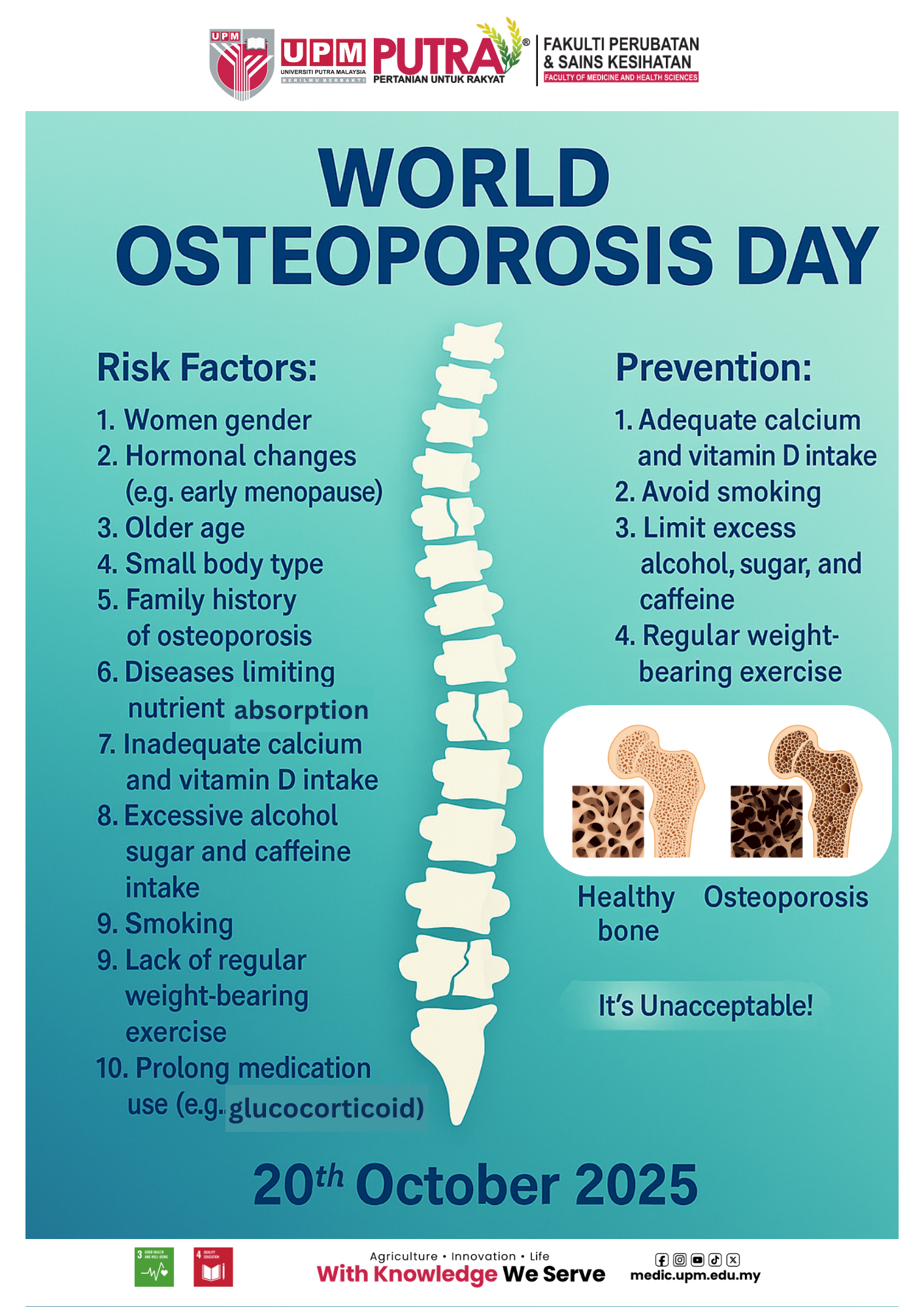
World Osteoporosis Day 2025: "It's Unacceptable!"
Observed annually on October 20th, World Osteoporosis Day (WOD) issues a powerful call to action: "It's Unacceptable!" This message demands that all of us stop treating bone health as merely an "old person's problem" and recognize the silent, escalating crisis for aging nations like Malaysia.
Understanding Osteoporosis: The "Silent Thief" and Fracture Risk
Osteoporosis—literally "porous bone"—is a disease where the breakdown of old bone outpaces the formation of new bone, causing the skeleton to become weak and fragile. Nicknamed the "silent thief," it steals bone strength painlessly for decades until a fragility fracture occurs from minimal stress (like a sneeze or a minor fall).
These fractures are life-altering events, often requiring surgery and hospitalization. Tragically, up to 20% of affected individuals die within one year due to complications, while many survivors face chronic pain and permanent loss of independence.
The Escalating Crisis in Asia and Malaysia
The crisis is highly concentrated in Asia, which was home to of the million people globally at high fracture risk in 2010. By 2050, half of all global hip fractures are projected to occur in Asia.
Malaysia is on the frontline of this surge. Its population aged over 50 will swell from 5.3 million (in 2013) to nearly 14 million by 2050. Consequently, Malaysia is forecast to see a 3.55-fold increase in hip fracture incidence by 2050, one of the steepest rises in the region.
Assessing Risk : Are Our Bones Safe?
While anyone can be affected, certain factors dramatically increase the risk of developing the disease. Individuals should take a moment to assess where they stand:
|
Uncontrollable (Internal) Factors
|
Controllable (External) Factors
|
| Age and Gender: Women are four times more likely to develop it compared to men (especially post-menopause). |
Lifestyle Habits: Smoking (toxic to
bone), excessive alcohol, and high
intake of caffeine or sugar. |
Hormone Changes: Early menopause, low
estrogen/testosterone. |
Dietary Deficiencies: Inadequate
Calcium and Vitamin D. |
Body Type (Small, thin frame) and Family
History (close relative had osteoporosis or a
fracture). |
Sedentary Lifestyle: Lack of regular
weight-bearing exercise. |
| Underlying Conditions (e.g., diseases limiting nutrient absorption). |
Medication Use: Prolonged use of
anti-inflammatory drugs (such as glucocorticoids). |
Diagnosis: The DXA Scan
Osteoporosis is diagnosed using a Dual-Energy X-ray Absorptiometry (DXA) scan, which measures Bone Mineral Density (BMD). The results are reported as a T-score, which defines bone health status: Normal (−1.0 and above), osteopenia (low bone mass, between −1.0 and −2.5), and osteoporosis (−2.5 or below).
DXA screening is recommended for all women over age 65, and for younger postmenopausal women or for men with significant risk factors.
Prevention: Diet, Exercise & Lifestyles
Prevention requires commitment to building and maintaining bone mass through diet, physical activity, and lifestyle changes.
Calcium is the skeleton's main building block, and Vitamin D acts as the crucial "key" that allows the body to effectively absorb and use that calcium. The recommended calcium intake is 1000-1200 mg/day, while vitamin D is 400 international units (IU) (1-12 months of age), 600 IU (1-70 years old), and 800 IU (>70 years old).
The dietary sources of calcium include dairy (milk, cheese, yogurt), leafy greens (broccoli, kale, Chinese cabbage), canned fish (sardines/salmon with bones), and fortified drinks (soy/almond milk).
While foods such as oily fish (salmon, mackerel, sardines), egg yolks, and fortified foods (some cereals and milk) provides some vitamin D, the most efficient and natural source is sunlight. Despite the year-round sun in Malaysia, Vitamin D deficiency is unfortunately common due to modern lifestyles. Individuals should aim for brief periods (approximately 10-30 minutes) of direct sun exposure, ideally during mid-morning. However, always be mindful of skin protection and avoid overexposure.
When intake from the diet is insufficient, supplements can help; however, the maximum safe intake (from food + supplement) is generally 2000-2500 mg of calcium and 4000 IU of Vitamin D for most adults. Exceeding these limits can increase the risk of side effects, such as kidney stones.
Exercise: Two Key Types
Aim for 45 minutes, three to four days a week, after consulting your doctor. Any activity that makes the body work against gravity or provides resistance helps stimulate the natural process of bone remodeling, which maintains bone mass.
- Weight-Bearing Exercise: Activities where you work against gravity, which is the most beneficial type for maintaining bone mass. Examples: Brisk walking, jogging, hiking, dancing, and climbing stairs.
- Strength/Resistance Training: Activities that use muscle force to pull on bones, stimulating bone growth and strengthening surrounding muscles. Stronger muscles also improve balance and prevent falls. xamples: Lifting free weights, using machines, or resistance bands.
Essential Habits
- Quit Smoking: Tobacco is toxic to bone cells and speeds up bone loss.
- Limit: Refined sugar, caffeine, and alcohol impair the absorption and promote the excretion of essential bone minerals.
- Prevent Falls: Improve balance with exercises like Tai Chi and remove home hazards like loose rugs / electrical cords to prevent the fractures that lead to severe disability.
Your Call to Action
For World Osteoporosis Day, take charge of your bone health:
- Assess your risk: Reliable risk check tools are available online.
- Talk to your doctor: If you have risk factors, ask for a DXA scan.
- Commit to regular exercise, bone-healthy nutrition, and positive lifestyle habits now. Bone health is a lifetime commitment. Let's make the neglect of this serious disease truly unacceptable by taking proactive steps today.

Dr. Nizar Bin Abd Manan
Pharmacology Unit
Department of Human Anatomy
Faculty of Medicine and Health Sciences
Universiti Putra Malaysia
Date of Input: 17/10/2025 | Updated: 22/10/2025 | nadia_rahman
MEDIA SHARING




.png)
.png)