“If I get dementia, remember that I am still the person you know and love”
Introduction
World Alzheimer’s Day, celebrated every September 21, is a global effort to raise awareness about dementia and challenge the stigma associated with Alzheimer’s disease and other dementias. The 2025 campaign theme: #AskAboutDementia, #AskAboutAlzheimer invites us to ask questions—about symptoms, treatment and care options, ways to reduce risk, and the support available to people with Alzheimer’s. Open conversations can accelerate early detection, improve the quality of care, and build public understanding of Alzheimer’s disease, including understanding how the condition affects the more than 55 million people worldwide living with dementia, as well as their caregivers.
What is Dementia and Alzheimer's disease?
As life expectancy increases, the percentage of adults over 60 years of age in the general population is rapidly increasing. This aging process increases the risk of cognitive and functional difficulties, including dementia. However, it is important to remember that dementia is not a normal part of the aging process. Dementia is an umbrella term for a variety of neurodegenerative diseases characterized by the progressive loss of cognitive skills. The condition has a significant impact on daily functioning and quality of life, and can increase the rate of mental health problems among affected individuals.
In Malaysia, the impact of dementia is becoming increasingly apparent. Data from the 2018 NHMS reported a prevalence rate of 8.5%.
At the current rate, the number of dementia patients is expected to almost triple to around 637,500–825,000 by 2050, an increase of around 312% reflecting Malaysia’s rapid journey towards super-aged status. Dementia also impacts the quality of life of caregivers, who often face physical, emotional, and social burdens.
Increasing age and female gender are among the most commonly reported risk factors for dementia worldwide. There are various causes of neurodegenerative dementia, with Alzheimer's disease being the leading cause, accounting for 60–70% of dementia cases. Other types include vascular dementia (10–20%), frontotemporal dementia (10%), Lewy Body dementia (5%), as well as several rare causes of neurodegenerative dementia. However, the majority of dementia patients do not receive a formal diagnosis because most family members still consider the symptoms of Alzheimer's disease to be a normal part of the aging process, resulting in delayed specialized medical treatment.
Alzheimer's disease begins with a prolonged preclinical phase (the presence of amyloid plaque pathology without clinical symptoms) that can last for more than a decade. This phase is followed by a prodromal phase (mild cognitive impairment) and ultimately progresses to full-blown dementia. Along this continuum, biological staging is guided by the presence of Aβ, tau, and neurodegeneration measured using PET scans and cerebrospinal fluid (CSF) biomarkers. Recently, blood-based biomarkers have emerged as a less invasive, more scalable, and more cost-effective early screening method, allowing for their wider use in research and clinical settings. In 2025, the FDA approved the Lumipulse G plasma pTau217/Aβ42 ratio, a blood test for the early detection of amyloid plaques in individuals aged 55 years and older who show signs or symptoms of Alzheimer's disease.
Why is it important to care?
Globally, every 3 seconds someone is diagnosed with dementia. In Malaysia, around 330,000 people are currently living with dementia — equivalent to 1 in 12 adults over the age of 60. By 2050, this figure is expected to triple, with an estimated economic burden of RM8 billion per year.
Alzheimer’s disease remains the leading cause of dementia, often associated with cerebral small vessel disease (CSVD), in which small changes in the brain’s blood vessels affect blood flow, accelerate cognitive decline, and increase the risk of dementia. Studies have also highlighted the role of the glymphatic system, the brain’s “waste clearance pathway.” When this system fails, harmful proteins such as amyloid-β and tau accumulate, further driving the development of Alzheimer’s disease.
On World Alzheimer’s Day (September 21), we are reminded that dementia is not just about memory loss — it involves individuals, families, and communities. Raising awareness, promoting early diagnosis, and strengthening research into mechanisms such as CSVD and glymphatic system dysfunction are essential for better prevention and care of Alzheimer’s disease. When we dare to ask the right questions, we open the door to earlier help, increase community empathy, and so hope for a future without dementia.

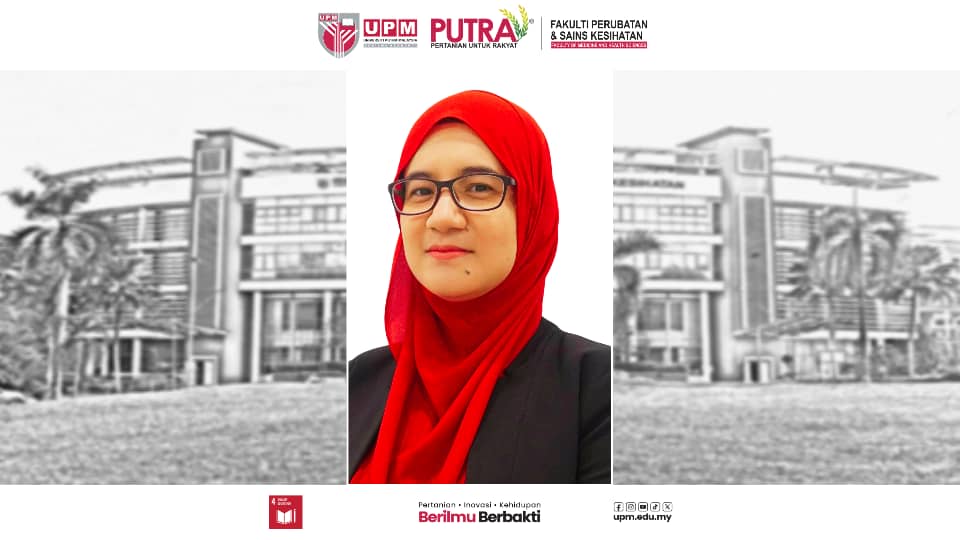
Dr. Hafizah Abdul Hamid
Senior Lecturer
Department of Human Anatomy
Faculty of Medicine and Health Sciences, Universiti Putra Malaysia
Date of Input: 21/09/2025 | Updated: 29/09/2025 | nadia_rahman
MEDIA SHARING





.png)
.png)