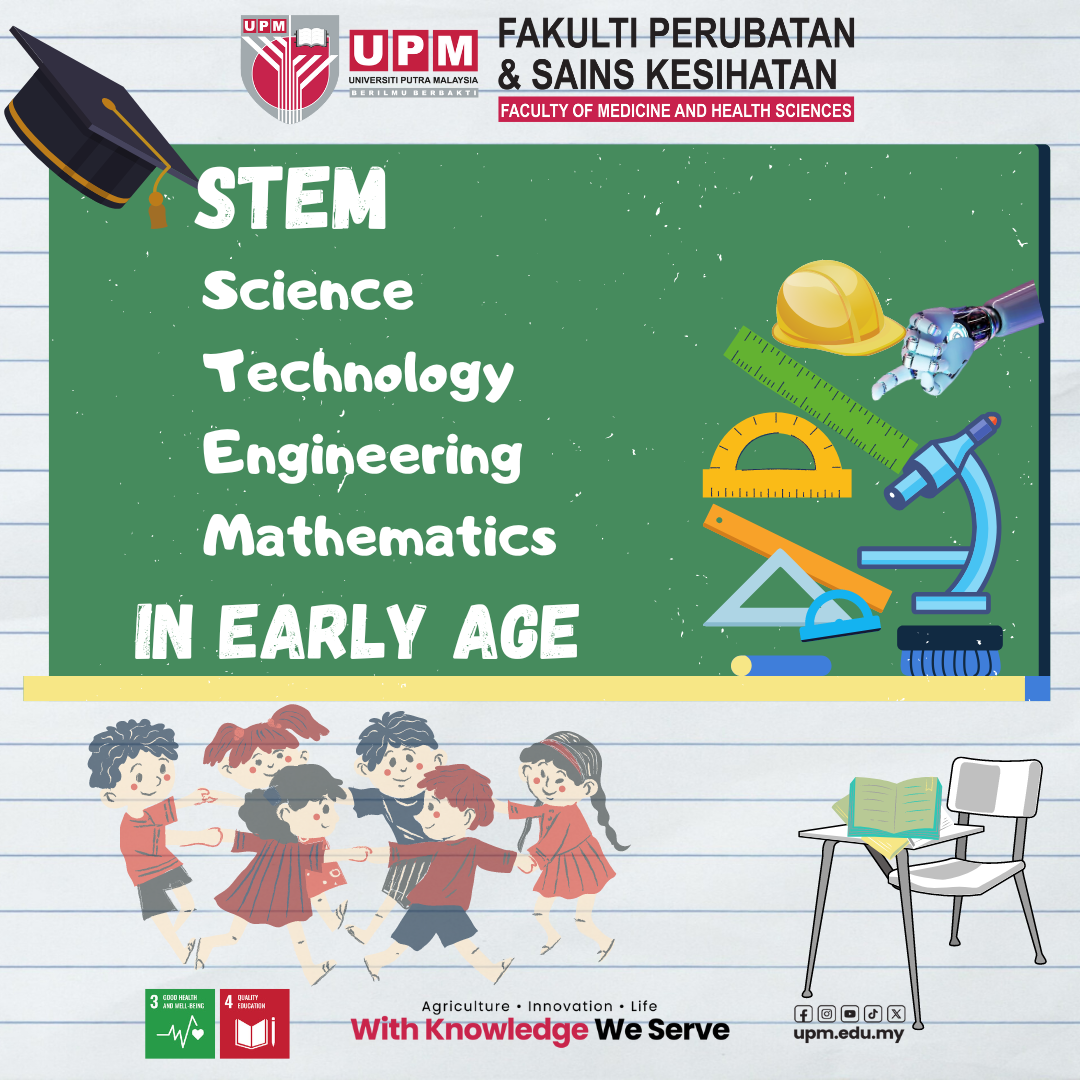
INTRODUCING STEM AT AN EARLY AGE HELPS NURTURE STUDENTS' INTEREST IN STEM
Children are the gems and future leaders of the nation in shaping the future. According to the United Nations Educational, Scientific and Cultural Organization (UNESCO), the care and education of children at an early age is more critical than merely preparing them to step into the school environment. It is important to fully focus on the overall development of young children, which includes social, emotional, cognitive, as well as strong basic and physical needs to ensure continuous and lasting learning.
This is because at the age of 3 to 7 years, children have an intense curiosity in exploration, enjoy asking various challenging questions and have a maximum level of creativity. Therefore, this age group is very suitable for being introduced to the basic concepts of STEM.
STEM is an acronym for Science, Technology, Engineering and Mathematics. Nevertheless, the introduction of STEM to children at an early age goes beyond just encouraging a passion for mathematics and science.
It stimulates children's curiosity and aids in the development of critical and creative thinking skills. As children's critical thinking abilities grow, they are further encouraged to respond to straightforward questions with more nuanced responses than just "yes" or "no." Indirectly, this results in improved linguistic proficiency as well.
The result of a feasibility study on the introduction of STEM in 19 PERMATA childcare centers, led by Associate Professor Dr. Mazlini Adnan from the Universiti Pendidikan Sultan Idris in 2016, demonstrated that children aged between 3 to 4 years are capable of learning STEM concepts effectively with proper guidance. This suggests that early exposure to STEM can lay a strong foundation for future learning and development in these subjects.
In fact, Malaysia's efforts to promote STEM education began as early as 1967, with the Higher Education Planning Committee (JKPPT) introducing a projected ratio of 60 percent of students majoring in science and 40 percent in literature. Since then, various initiatives have been undertaken to strengthen STEM education among school students, aiming to foster a strong foundation in science, technology, engineering, and mathematics.
In 2016, in collaboration with three ministries in Malaysia, namely the Ministry of Science, Technology and Innovation (MOSTI), the Ministry of Education Malaysia (KPM), and the Ministry of Higher Education (KPT), a National STEM Action Plan 2017-2025 was formulated to support the government’s efforts in fostering interest in STEM among school students.
To further enhance the government’s efforts, in May 2024, Malaysia’s minister of Education, Mrs Fadhlina Sidek stated that the Malaysian Ministry of Education together with the Ministry of Science, Technology, and Innovation (MOSTI) will implement a joint program with scientists in 100 schools nationwide. In addition, a STEM Special Committee will also be established to ensure the direction of STEM is strengthened.
This is in line with the government's aim to produce more Malaysians who can cultivate science and technology in life in addition to being competitive in helping the country achieve the status of a developed country. However, despite all the efforts, research and allocations that have been invested by the government, why is there a significant decline among students who major in science?
The decline in students taking science, technology, engineering, and mathematics (STEM) subjects in Malaysia is a long-standing issue, with concerns dating back to the 2010 OECD report. The percentage of students pursuing STEM fields has continued to decline over the years, with only 44 percent of students taking STEM subjects in 2019, down from 49 percent in 2012. The trend has continued, with only 19 percent of students out of approximately 447,000 candidates who sat for the Third Form Assessment (PT3) examination choosing to enter the science stream in 2020 as reported by the Chairman of the National STEM Movement, Prof Datuk Dr Noraini Idris. In fact, in 2023, only 15.2 percent of students majored in science.
Based on research conducted, the decline in student interest in STEM fields is due to poor mastery of science, technology, and mathematic concepts. Science and mathematics subjects are also considered difficult subjects to learn. This causes many students to worry if they receive a low exam score.
The lack of exposure to diverse career fields in STEM is also a contributing factor to this decline. It should be emphasized that this culture and interest in STEM needs to be empowered to support the government’s efforts to implement the 2027 School Curriculum whose target is to produce a globally competitive generation.
Therefore, what is the association between fostering an interest in STEM at an early age and the probability that students will be interested in science when they are in school later? Children have a high curiosity and love to experiment. By encouraging curiosity and experimentation, children can develop a sense of confidence and competence in science and mathematics, which can help alleviate any feelings of ineptness or difficulty when they enter primary and secondary school. This early exposure can lay the foundation for a lifelong interest in STEM subjects, setting them up for success in their future educational and professional pursuits.
A strong interest and deep curiosity towards STEM can help overcome the feelings of difficulty and anxiety in mastering this field. Moreover, it would be even better if this interest is nurtured from the preschool level through the cultivation of science-based thinking skills, encouraging more creative play activities, and fostering two-way communication that can help them further develop strong cognitive skills.
Preschool and elementary school teachers can help by preparing simple and interesting science experiments as well as providing explanations that are easy to understand. In addition, parents can also aid these young children in understanding science better. Furthermore, everything that happens around us is inextricably linked.
Unconsciously, we have also intertwined with science that is everywhere such as sensory stimulation, nature, daily life practices and even looking up high into the blue sky. The most basic examples of science that are easiest to learn are the explanation behind how it rains, the cycle of day and night and how rainbows are formed after rain.
This simple science foundation will indirectly attract children to keep asking questions and think critically. The preparation of straightforward and illustrated science reading materials can also help young children understand them well. It is important for parents or teachers to explain it in language and analogies that are easy for young children to understand. In this age of increasingly advanced technology, the use of smartphones with the supervision of parents or guardians can also help foster an interest in STEM in young children and provide an interactive platform for learning with variety of age-appropriate apps and materials.
However, it is essential to strike a balance between exposure to STEM concepts in children at this early age which needs to be nurtured slowly to ensure that interest remains constant. Thus, collaboration from all stakeholders—parents, educators, and the Malaysian Ministry of Education in particular—is crucial in preventing the nation’s students from falling behind in achieving the country's goal to continue progressing in the STEM fields.

Ts. Dr. Sharifah Sakinah Syed Alwi
Senior Lecturer
Department of Biomedical Sciences
Faculty of Medicine and Health Sciences, Universiti Putra Malaysia
Date of Input: 06/08/2024 | Updated: 09/08/2024 | qayyumalemilhadie
MEDIA SHARING






.png)
.png)